.webp)
Aniimo Evolution Requirements: Why Leveling Alone Is Not Enough
Aniimo Evolution Requirements: Why Leveling Alone Is Not Enough
In Aniimo, evolution looks simple when viewed from a distance: catch a creature, raise its level, collect the necessary resources, and transform it into a stronger form. The reality is considerably more complicated. Evolution is not simply a reward for reaching a certain level. Many evolution routes combine a level requirement with additional conditions such as defeating a particular Alpha, visiting a specific location, meeting a time or weather condition, possessing a certain personality or potential, or completing a special challenge.
This creates a very specific progression problem: a player can spend hours training the correct Aniimo, reach the expected level, collect evolution materials, and still be unable to evolve it. The creature is not necessarily broken, and the player has not necessarily missed a basic menu option. In many cases, the missing piece is another condition attached to that particular evolution route. Understanding this system changes how you should approach creature collection from the moment you capture an Aniimo. Instead of treating evolution as the final step of leveling, it is more useful to treat evolution as a long-term objective that begins when the creature enters your roster.
1. The First Problem Appears When You Expect Evolution to Happen Automatically
Early in an Aniimo playthrough, it is natural to assume that a creature will evolve automatically after reaching the required level. That assumption comes from years of creature-collection games where leveling is the main trigger for transformation. Aniimo handles the process differently. Evolution is manually initiated through the creature-management interface rather than simply appearing as an automatic level-up event.
That distinction matters because the moment you stop expecting an automatic transformation, you begin paying attention to the actual requirements attached to the evolution branch. Leveling remains important, but it becomes only one part of the preparation process. The correct question is no longer “What level does this Aniimo evolve?” but “What does this specific evolution route require?”
Evolution Is a Checklist, Not a Single Threshold
An evolution can be thought of as a checklist containing several independent conditions. Depending on the creature and branch, those conditions can involve the Aniimo's level, an evolution item, an Alpha or Omega encounter, a location, weather, time of day, a challenge, or characteristics of the individual creature.
The practical consequence
If an Aniimo refuses to evolve, increasing its level should not automatically be your next action. First identify which requirement has not been satisfied. Otherwise, you can spend significant time earning experience without changing the actual state of the evolution condition.
2. The Second Stage Is Identifying the Exact Evolution Branch
Once you understand that evolution is conditional, the next challenge is identifying the destination you actually want. Aniimo does not treat every evolution as a simple linear “small creature becomes bigger creature” process. Evolution families can contain different stages and, in some cases, branching routes.
This becomes especially important when a creature has more than one possible destination. A player who only looks at the final form may overlook the requirements attached to the route leading there. Two visually similar progression goals can require completely different activities. One route might ask you to defeat an Alpha, while another could require a challenge or environmental condition. Therefore, deciding the evolution route should happen before you begin serious resource farming.
The problem becomes even more noticeable for collectors who capture several copies of the same species. Instead of assuming that every copy is interchangeable, you should inspect the individual characteristics and the requirements of the desired branch. This is where Aniimo's evolution system begins to resemble a planning problem rather than a conventional leveling system.
3. Leveling Comes First, But It Is Only the Foundation
After choosing a route, leveling is still the most obvious preparation step. Many evolution paths specify a creature level, and individual evolution routes can have very different thresholds. There is no universal level at which every Aniimo evolves.
The important distinction is between progress toward evolution and completion of evolution requirements. Experience moves the first category forward. It does not automatically solve the second. If your creature has reached its required level but the evolution option remains unavailable, continuing to farm ordinary enemies may provide little value for that particular objective.
Why Over-Leveling Can Waste Time
Over-leveling is not necessarily harmful in a general sense, but it can be inefficient when your goal is a specific evolution. Suppose the required level is already satisfied and the missing condition is an Alpha encounter. Ten additional battles may make the Aniimo stronger, but they do not replace the required Alpha objective.
A better progression habit is to divide your preparation into three questions:
- Has the Aniimo reached the required level?
- Has every special condition been completed?
- Do I have the required evolution material or item?
Only when all three categories are satisfied does additional ordinary grinding become unnecessary for the evolution itself.
4. The Hidden Requirement Is Often the Real Barrier
The most interesting part of Aniimo's evolution system is that some requirements are not simply numerical. Evolution conditions can involve specific Alpha or Omega defeats, exact locations, weather, time of day, personality-related attributes and other contextual triggers.
This changes the player's relationship with the open world. If evolution were determined entirely by level and items, the optimal strategy would be relatively straightforward: fight enemies, gain experience, collect currency, and activate the evolution. Environmental conditions create a different loop. The world itself becomes part of the evolution process.
Why Location and Time Matter
A requirement such as reaching a particular location is fundamentally different from collecting a resource. Resources can usually be accumulated and stored. A location condition asks you to physically return to the world and perform the evolution preparation under the correct circumstances. A weather or time condition goes one step further because the world state becomes part of the requirement.
For players who rush through objectives, this can feel like an invisible wall. For players who treat Idyll as a system to investigate, it creates a reason to revisit areas that might otherwise become irrelevant after their first visit.
5. Alpha and Omega Objectives Turn Evolution Into Combat Preparation
Another important category is the requirement to defeat a named Alpha or Omega. This is more significant than a simple checklist because the evolution condition can force you to prove that the creature has participated in a particular combat objective.
This means that an evolution target should influence your combat planning before the creature reaches its final level requirement. If you wait until the creature is already at the required level, only then discover that an Alpha must be defeated, you may need to reorganize your team, travel to another region and prepare for an encounter you had not planned around.
Build the Evolution Objective Into Your Battle Route
A more efficient approach is to combine activities. While leveling the target Aniimo, identify the Alpha associated with its evolution route. Then prepare your team around that encounter rather than treating it as a completely separate task.
This creates a simple progression chain:
- Choose the desired evolution.
- Record its required level.
- Identify its Alpha, Omega or special combat condition.
- Prepare the appropriate combat team.
- Level the target Aniimo while progressing toward the encounter.
- Complete the special battle before returning to the evolution menu.
The benefit is not simply speed. You reduce the chance of reaching the level requirement and then discovering that your team is poorly prepared for the required encounter.
6. Evolution Materials Should Be Farmed After the Route Is Known
Evolution materials create another possible source of wasted effort. It is tempting to gather every evolution-related resource you encounter, especially in an open-world RPG where exploration naturally produces materials. However, material farming becomes much more efficient once the destination form is known.
Evolution routes can require different materials, and some routes may not require an evolution item at all. This means that “I have an evolution stone” does not necessarily mean “I can evolve this Aniimo.” The material must match the particular route.
Do Not Confuse Possessing a Material With Satisfying the Evolution
Imagine that your Aniimo has reached its required level and you have collected an evolution stone. If the route additionally requires an Alpha defeat or a location condition, the material alone cannot complete the process. This is why material farming should be treated as one component of preparation rather than the definition of readiness.
A useful inventory check before attempting an evolution is therefore:
- Correct Aniimo copy.
- Correct evolution branch.
- Required creature level.
- Required evolution material.
- Required combat objective.
- Required location, time or weather condition.
- Any individual-specific requirement shown by the evolution route.
7. Individual Aniimo Characteristics Can Change the Decision
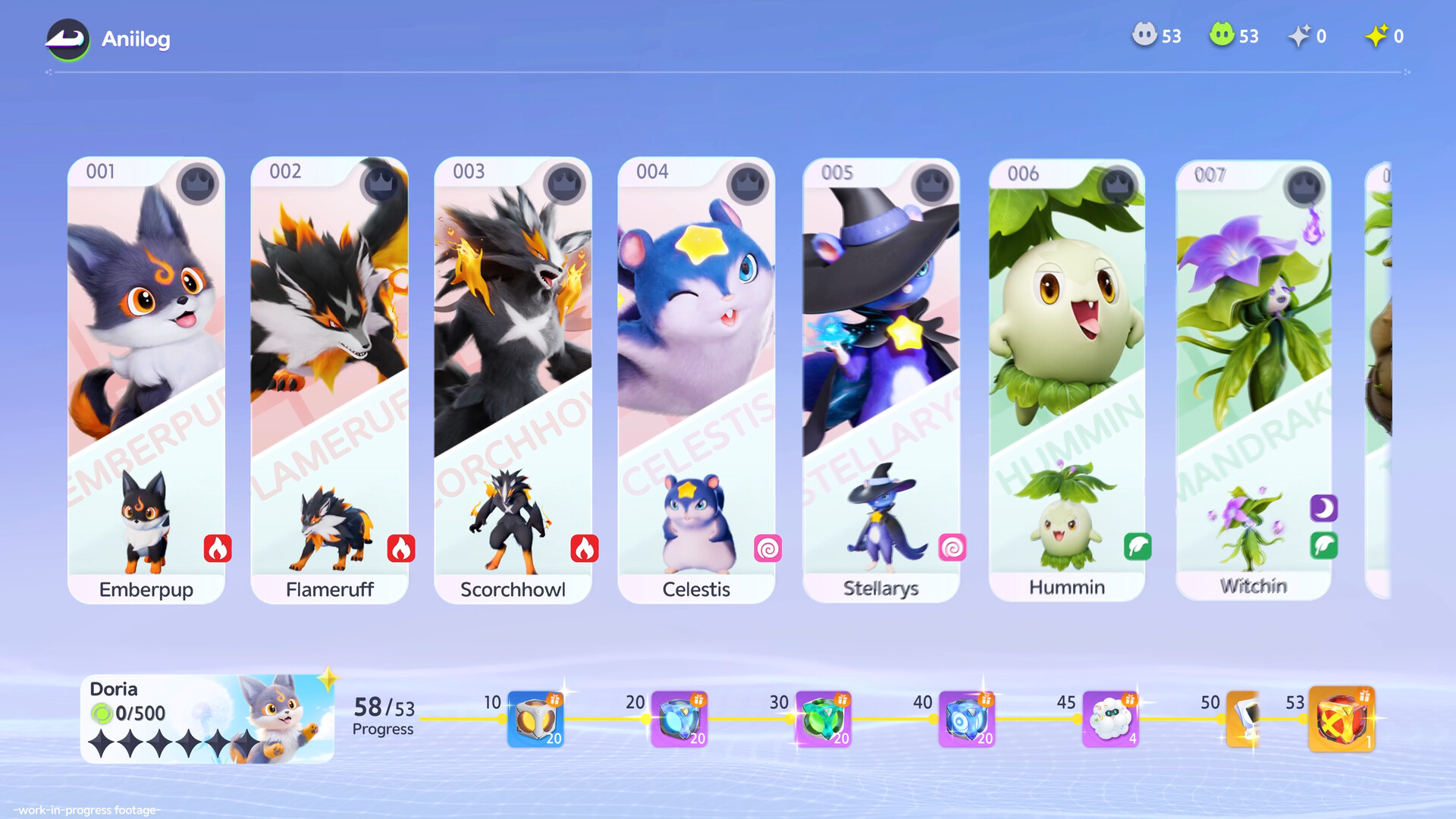
The evolution problem becomes deeper when the requirement is tied to the individual creature rather than simply the species. Some evolution routes can involve characteristics such as personality or potential. This means that capturing a second copy of the same species may not necessarily produce an identical evolution candidate.
For collectors, this is an important distinction. If you are trying to build a long-term roster, immediately investing every resource into the first copy you capture may not always be the most informed approach. You should first determine whether the individual has the characteristics required for the form you want.
Capture Quality and Long-Term Planning
The game's collection loop encourages players to pay attention to individual Aniimo rather than treating every capture as identical. When evolution requirements are added to that system, the capture itself becomes the beginning of a decision.
The question is no longer simply “Did I catch this species?” It becomes “Did I catch an individual worth investing in, and does it fit the evolution route I want?”
That distinction can save a considerable amount of time. Training an unsuitable individual to a high level before discovering that another copy would have been a better candidate creates unnecessary grinding.
8. Twining Makes Evolution More Important Than a Stat Upgrade
Evolution deserves special attention in Aniimo because an evolved creature is not merely a stronger number on a roster screen. The game's Twining system allows the Pathfinder to merge with a collected Aniimo and use that creature's abilities for combat, puzzles and traversal.
That makes an evolution decision potentially affect exploration as well as combat. If an evolved form changes abilities, movement characteristics or combat functionality, the route can influence how you approach parts of Idyll. Evolution therefore connects three systems that might initially look separate: creature development, combat preparation and world traversal.
Evolution as a Traversal Decision
Aniimo's open world is designed around different movement possibilities, including gliding, diving and burrowing. If your preferred evolution changes the capabilities available through Twining, then the evolution route becomes relevant to exploration planning.
This is why it is useful to avoid thinking exclusively in terms of “stronger form.” A better question is “What will this form allow me to do?” For one player, combat performance may be the priority. For another, exploration or puzzle access may matter more.
The evolution system can therefore be evaluated according to the role the creature plays in the broader gameplay loop.
9. The Efficient Method Is to Plan Backward From the Final Form
Once the different requirement categories are understood, the most reliable approach is to work backward. Start with the form you want, then identify everything required to reach it. This is more efficient than blindly leveling a creature and checking the evolution menu only after every other activity is finished.
For example, suppose the final form requires a high creature level, a specific Alpha defeat and a special environmental condition. Your preparation can then be divided into parallel activities. Level the Aniimo through normal exploration, locate the relevant Alpha while traveling, gather the required material, and monitor the environment for the final trigger.
A Practical Evolution Workflow
The following sequence minimizes unnecessary grinding:
- Select the destination form. Do not begin serious farming before deciding which route matters.
- Inspect every listed requirement. Separate numerical, material, combat and environmental conditions.
- Check the individual Aniimo. Make sure the creature itself satisfies any copy-specific requirement.
- Level efficiently. Gain experience while completing other objectives rather than grinding only for experience.
- Complete combat requirements. Defeat required Alpha or Omega targets before reaching the final menu check.
- Gather the exact material. Avoid assuming that a generic evolution item will work for every branch.
- Return to the required location or wait for the required condition.
- Open the evolution interface and verify the final checklist.
The key principle
Every activity should ideally solve more than one problem. If you are traveling toward an Alpha, use the route to gather materials. If you are farming experience, use the same fights to improve the creature's readiness for a larger encounter.
This turns evolution from a collection of isolated chores into one continuous progression route.
10. Why Understanding Evolution Changes the Entire Aniimo Progression Loop
The deeper issue with Aniimo's evolution system is not that the requirements are complicated individually. Most individual requirements are understandable. The difficulty comes from their combination. A creature can simultaneously need the correct level, the correct item, the correct battle objective and the correct environmental condition.
When these systems overlap, evolution becomes an information-management problem as much as a progression mechanic.
That is also why blindly following a level guide can be misleading. A level threshold is only one part of the route. Evolution information can include levels, Alpha or Omega defeats, locations, weather, time and individual characteristics. The exact requirements should therefore be checked for the specific Aniimo and branch you are pursuing rather than assumed from another species.
Conclusion
Aniimo's evolution system becomes much easier to understand once you stop treating level as the finish line. Reaching the required level is often only the foundation. The real challenge can be an Alpha victory, an exact location, a time or weather condition, a specific material, a special challenge, or a characteristic of the individual Aniimo you chose to train.
This makes preparation more important than raw grinding. The strongest approach is to choose the desired evolution first, inspect its complete requirement list, and then organize exploration, battles, material collection and leveling around that goal. Doing so prevents one of the most frustrating progression situations in Aniimo: spending hours strengthening a creature only to discover that the final evolution requirement was something completely different.
More importantly, the system gives evolution a role beyond simple statistical growth. Because Aniimo can be used through Twining for combat, puzzles and traversal, an evolution can influence how you interact with the world itself. Once players begin planning around complete evolution routes instead of isolated level thresholds, the open world becomes part of the progression system rather than merely the place where experience is earned.